
Higher energy density is increasingly important for UAVs, robotics, and other demanding applications where battery weight directly affects system performance.
An NCM + Si-C battery combines NCM cathode chemistry with silicon-carbon anode technology to achieve higher energy density. NCM helps increase energy through higher cathode capacity and operating voltage, while silicon-carbon offers much higher theoretical capacity than graphite. The key challenge is turning these material advantages into stable, consistent cell performance.
1. What Is NCM + Si-C Battery Technology?
NCM + Si-C battery technology combines two advanced electrode material systems within the same lithium-ion cell.
NCM stands for Nickel Manganese Cobalt and refers to the cathode material.
Si-C stands for silicon-carbon and refers to a composite anode material that incorporates silicon into a carbon-based structure.
The basic concept is to improve energy-storage capability from both sides of the cell rather than relying on a single material improvement.
For conventional lithium-ion batteries, graphite has been widely used as the anode material. Its theoretical specific capacity is approximately 372 mAh/g. Silicon, by comparison, has a theoretical specific capacity of approximately 3,579 mAh/g.
This difference creates an opportunity to increase anode-side energy-storage potential, while NCM provides another pathway through cathode capacity and voltage.
However, higher theoretical capacity alone does not guarantee better practical battery performance. Material stability, interface behavior, cycle performance, and manufacturing consistency must also be considered.

2. Why Does NCM + Si-C Enable Higher Energy Density?
Battery energy density describes how much energy a battery can store relative to its weight.
For applications such as UAVs and robotics, increasing energy density can help engineers increase available energy while working within strict weight and space constraints.
The challenge is that conventional graphite anodes are approaching their practical performance limits after decades of optimization.
At the same time, increasing energy from the cathode also requires careful control of material stability.
NCM + Si-C addresses these two areas together:
- NCM cathode: higher nickel content can contribute to higher capacity, while higher operating voltage can provide additional energy.
- Si-C anode: silicon provides substantially higher theoretical lithium-storage capacity than graphite.
The combination creates a pathway toward higher cell-level energy density.However, the engineering challenge lies in making these theoretical advantages practical without compromising stability and cycle performance.
3. How Does NCM Improve Battery Energy Density?
NCM is an important cathode chemistry for high-energy-density lithium-ion battery development.
3.1 Higher Nickel Content Can Increase Cathode Capacity
As nickel content increases, NCM materials can provide higher capacity.
This creates an opportunity to increase the amount of energy stored in the cathode while maintaining a practical cell design.
3.2 Higher Voltage Can Increase Available Energy
Operating voltage also affects how much energy can be extracted from the cathode.
MXARI’s NCM platform supports a charging cutoff of up to 4.3 V. A higher charging voltage can provide access to additional energy from the cathode material.
However, higher voltage introduces additional challenges.
Higher-voltage operation can place greater stress on the cathode crystal structure and accelerate electrolyte oxidation. These effects can contribute to material degradation and affect long-term cell performance.
3.3 How Does MXARI Address High-Voltage NCM Challenges?
MXARI applies material engineering approaches including:
- Bulk doping
- Surface coating
These approaches are used to improve cathode structural stability and help manage the challenges associated with high-voltage operation.
The objective is not simply to increase the operating voltage, but to balance higher energy with practical cell stability and performance.
4. How Does Silicon-Carbon Improve Battery Energy Density?
The anode represents another major opportunity for increasing lithium-ion battery energy density.
4.1 Silicon Offers Much Higher Theoretical Capacity Than Graphite
Graphite has a theoretical specific capacity of approximately 372 mAh/g.
Silicon has a theoretical specific capacity of approximately 3,579 mAh/g, nearly ten times that of graphite.
This makes silicon an attractive material for high-energy-density battery development.
4.2 What Is the Main Challenge of Silicon Anodes?
The key challenge is silicon’s substantial volume change during lithiation.
Silicon can experience approximately 300% volume expansion during lithiation.
Repeated expansion and contraction can damage silicon particles and repeatedly rupture the solid electrolyte interphase (SEI). This can consume active lithium over successive cycles and contribute to capacity degradation.
Therefore, simply increasing the silicon content is not enough. The material structure and electrode interface also need to be engineered for practical operation.
4.3 How Does Silicon-Carbon Technology Address These Challenges?
A silicon-carbon composite combines silicon with a carbon-based structure designed to better accommodate silicon’s volume changes.
MXARI’s approach includes:
- Carbon matrix structures to help buffer silicon expansion
- Binder systems to support electrode integrity
- Electrolyte additive systems to help stabilize the SEI
The goal is to make better practical use of silicon’s high theoretical capacity while reducing the impact of its volume expansion and interface instability.
5. What Are the Main Challenges of NCM + Si-C Battery Development?
NCM + Si-C technology can enable higher energy density, but turning these material advantages into practical cell performance requires careful control of several engineering challenges.
5.1 High-Voltage NCM Stability
Higher NCM operating voltage can increase available energy, but it can also place additional stress on the cathode structure and accelerate electrolyte oxidation.
5.2 Silicon Volume Expansion
Silicon’s large volume change during lithiation and delithiation can affect electrode integrity and long-term cycle performance.
5.3 SEI Stability
Repeated silicon expansion and contraction can disrupt the SEI and contribute to active-lithium loss.
5.4 Manufacturing Consistency
Material-level advantages must ultimately translate into repeatable cell manufacturing. Consistent performance between cells and production batches is therefore an important part of practical high-energy-density battery development.
6. How Does MXARI Apply NCM + Si-C Technology?
MXARI applies NCM + Si-C battery technology to the development and production of high-energy-density lithium battery cells.
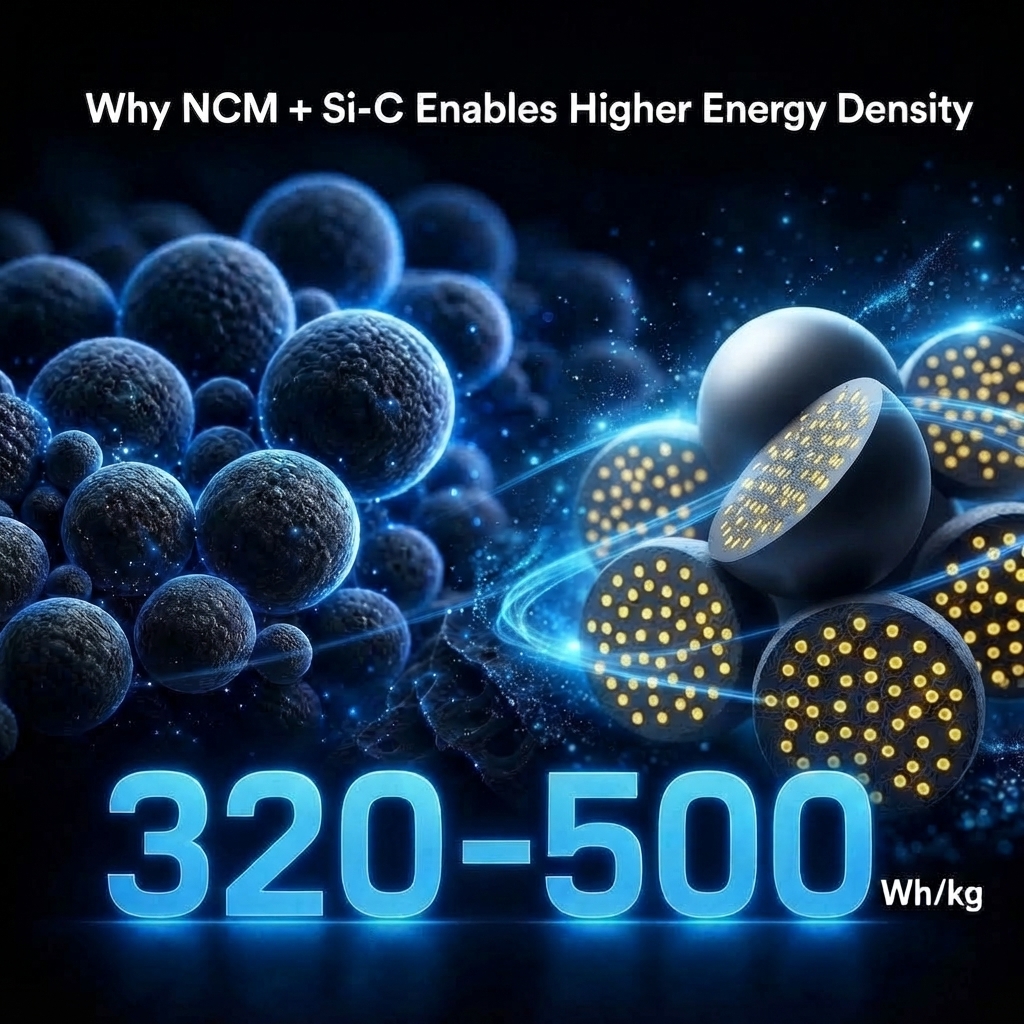
MXARI high-energy cells cover approximately 320–500 Wh/kg, depending on cell design and configuration.
The technology platform is intended for applications where battery weight, available energy, and power capability are important design considerations.
Rather than relying on one material improvement, the NCM + Si-C approach combines cathode and anode engineering to increase the energy-density potential of the complete cell.

Explore MXARI’s high-energy-density battery solutions
7. Where Are NCM + Si-C Battery Cells Used?
7.1 UAV and Drone Applications
UAVs often operate under strict weight limitations, making battery energy density an important design factor.
Higher cell-level energy density can help engineers increase available energy while maintaining a constrained battery weight budget.
For long-endurance UAV applications, energy density should be evaluated together with capacity, discharge capability, cell dimensions, weight, and cycle performance.
Explore MXARI UAV Energy Systems
7.2 Robotics
Mobile robots and autonomous systems may require both extended operating time and sufficient power for changing load conditions.
NCM + Si-C cells can provide an option for applications where battery weight, available energy, and power capability need to be balanced.
7.3 Other Weight- and Space-Constrained Applications
Portable power systems and other demanding platforms may also benefit from high-energy-density lithium battery cells.
The appropriate cell should always be selected according to the specific application requirements and complete battery architecture.
8. How Should High-Energy-Density Battery Cells Be Evaluated?
Energy density should not be evaluated as a single number.
For engineers and procurement teams, a meaningful technical evaluation should consider the complete cell specification and the conditions behind the performance data.
Important factors include:
- Cell chemistry
- Capacity
- Operating voltage
- Discharge conditions
- Cycle performance
- Cell design and configuration
- Testing methodology
For example, a high Wh/kg value should always be considered together with the cell’s operating conditions and other performance characteristics.This provides a more useful basis for comparing battery cells for a specific application.
9. Why Does NCM + Si-C Matter for High-Energy Battery Development?
The development of higher-energy lithium-ion batteries is increasingly a materials engineering challenge. NCM cathodes offer a pathway toward higher capacity and higher-voltage operation, while silicon-carbon anodes provide substantially greater theoretical lithium-storage capacity than conventional graphite.
The value of NCM + Si-C lies in addressing both sides of the cell together. The key is not simply achieving higher theoretical capacity, but translating these material advantages into practical cell performance through careful control of cathode stability, silicon expansion, SEI behavior, electrode design, and manufacturing consistency.
MXARI applies NCM + Si-C technology to high-energy-density lithium battery cell development, with high-energy cells covering approximately 320–500 Wh/kg.
For samples, datasheets, or application-specific technical information, contact MXARI to discuss your requirements.
No responses yet