
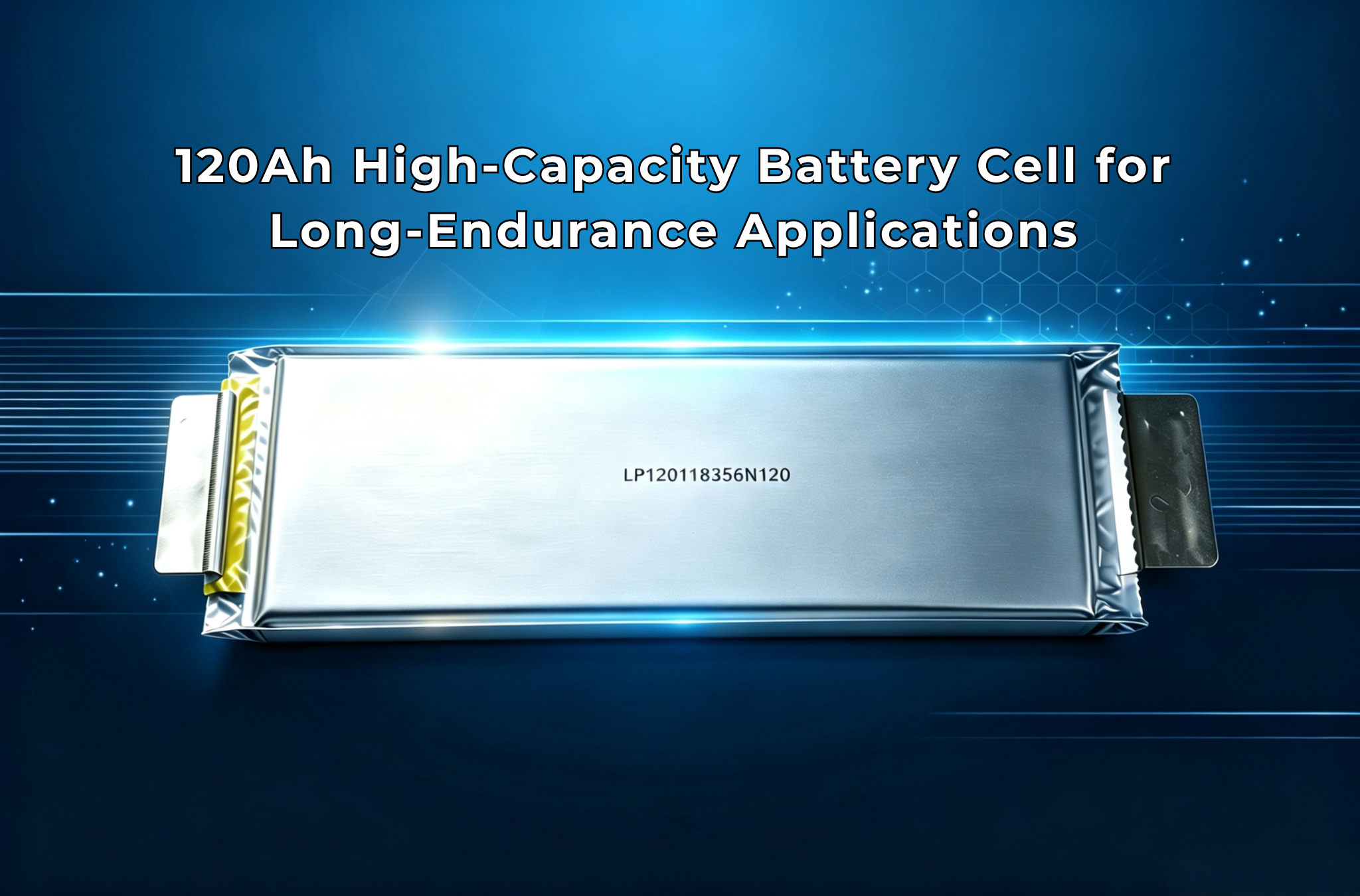
For long-endurance platforms, battery performance directly affects range, weight, and system design.
A 120Ah battery cell provides high capacity in a single cell, potentially reducing the number of cells and interconnections required at pack level.
For UAVs, robotics, portable power systems, and other demanding applications, high-capacity pouch cells offer a practical balance of energy, weight, size, and power capability.

1. Why 120Ah Capacity Matters for Long-Endurance Applications
Long-endurance battery systems face a basic challenge: increasing available energy without continuously increasing pack weight and complexity.
A battery pack contains more than active cells. It may also require cell interconnections, tabs, busbars, sensing wires, mechanical supports, and other components. As the number of cells increases, these supporting components can add weight and complexity to the overall system.
A 120Ah battery cell allows more energy to be concentrated into fewer cells. Depending on the battery architecture, this can help reduce the number of parallel branches and electrical interconnections required.
For long-endurance applications, the goal is therefore not simply to increase capacity. The more important question is how much usable energy can be delivered within the available weight and space budget.
2. What Makes a High-Capacity Pouch Cell Suitable?
Capacity is only one part of battery cell selection. Engineers and battery pack manufacturers typically evaluate several parameters together:
- Energy density — energy stored relative to cell weight
- Capacity — the amount of charge available from the cell
- Discharge capability — whether the cell can meet continuous and peak power requirements
- Dimensions — whether the cell fits the available mechanical space
- Weight — its contribution to overall pack weight
- Cycle life — expected performance over repeated charging and discharging
- For applications where energy, weight, and space are closely constrained, a high-capacity pouch cell can be an attractive option.
3. Key Advantages of a 120Ah High-Capacity Battery Cell
3.1 398Wh/kg Energy Density
For weight-sensitive applications, energy density is an important consideration.
At 398Wh/kg, a high-capacity cell can provide a substantial amount of stored energy relative to its weight. This is particularly relevant for UAVs, robotics, and other applications with strict weight budgets.
Higher cell-level energy density can help engineers work toward greater available energy without increasing battery weight at the same rate.
3.2 120Ah Capacity and 420Wh Energy
A 120Ah capacity provides 420Wh of nominal energy at 3.50V.
Using higher-capacity cells can potentially reduce the number of cells and parallel branches required to achieve a target pack capacity, depending on the system architecture. Fewer cell-level interconnections may also help simplify the physical design of the battery pack.
Explore MXARI’s 120Ah NCM/Si-C pouch cell
3.3 1–2C Continuous and 3C Pulse Discharge
The cell supports 1–2C maximum continuous discharge and 3C pulse discharge for 10 seconds.
For a 120Ah cell, this corresponds to up to 240A at 2C continuously and 360A during a 10-second 3C pulse.
This provides flexibility for systems that require both sustained power and short-duration peak output.
3.4 Large-Format Pouch Cell Design
A high-capacity cell also needs to fit the mechanical requirements of the battery system.
With a defined pouch-cell format, engineers can evaluate the cell against the available battery space, weight budget, and overall pack architecture.
Cell dimensions should always be considered together with the complete pack design rather than evaluated independently.

4. Applications for 120Ah High-Capacity Battery Cells
4.1 Long-Range UAVs
UAVs often face strict battery weight limitations while requiring sufficient energy for extended operation. A high-capacity, high-energy-density cell can help engineers balance endurance, weight, and available battery space.
4.2 Robotics
Robotic and autonomous systems may require both long operating time and temporary increases in power demand. A high-capacity cell with continuous and pulse discharge capability can support different operating profiles.
4.3 Portable Power Systems
For portable power equipment, battery capacity directly affects operating time. High-capacity pouch cells can provide another option for systems designed around specific weight and space requirements.
5. How to Select the Right 120Ah Battery Cell?
A 120Ah rating alone does not determine whether a cell is suitable for a specific application. Before selecting a cell, battery designers and procurement teams should consider:
- System voltage — determine the required series configuration.
- Required energy and capacity — compare the target pack requirements with the cell’s nominal energy and capacity.
- Continuous and peak power — evaluate both sustained and short-duration power demands.
- Available space and weight — confirm that the cell can be integrated within the intended battery architecture.
The right cell should be selected based on the complete system requirements rather than capacity alone.
6. MXARI High-Energy-Density Battery Cell Portfolio
The 120Ah cell is part of MXARI’s broader high-energy-density battery cell portfolio.
MXARI develops advanced lithium battery cells using technologies including NCM, Silicon-Carbon, lithium-metal, and solid-state battery technologies, with cell energy density across a range of approximately 320–500Wh/kg.
Different applications require different combinations of capacity, energy density, discharge capability, dimensions, and chemistry. For projects requiring a different capacity, size, or performance profile, cell selection and custom development can be evaluated according to specific project requirements.
Looking for a 120Ah battery cell for your next project? Request a datasheet or discuss your requirements with the MXARI battery team.
Comments are closed